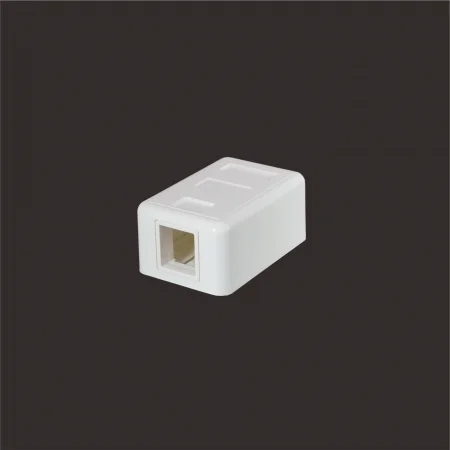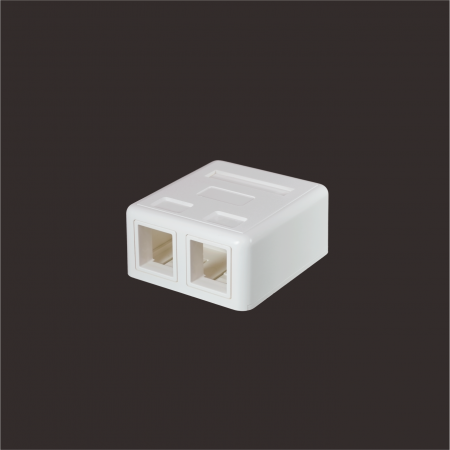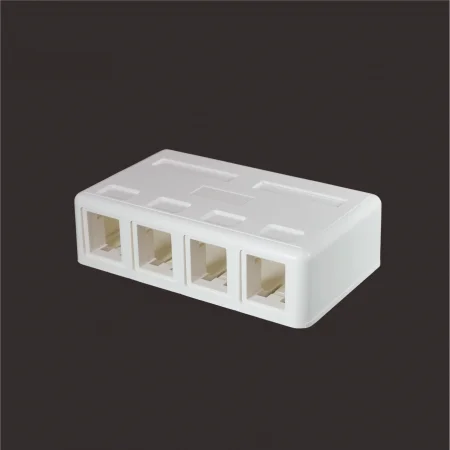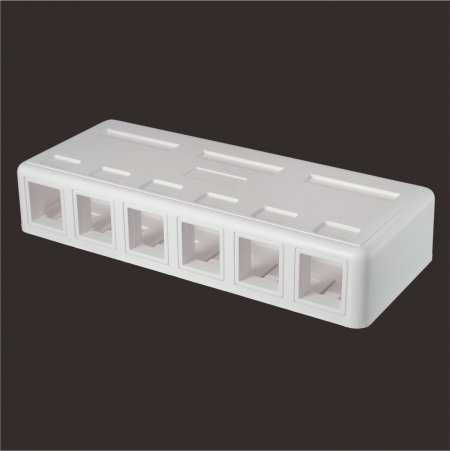
SMB Series
1/2/4/6/12-Port
Multi-User Telecommunication Outlet Assembly
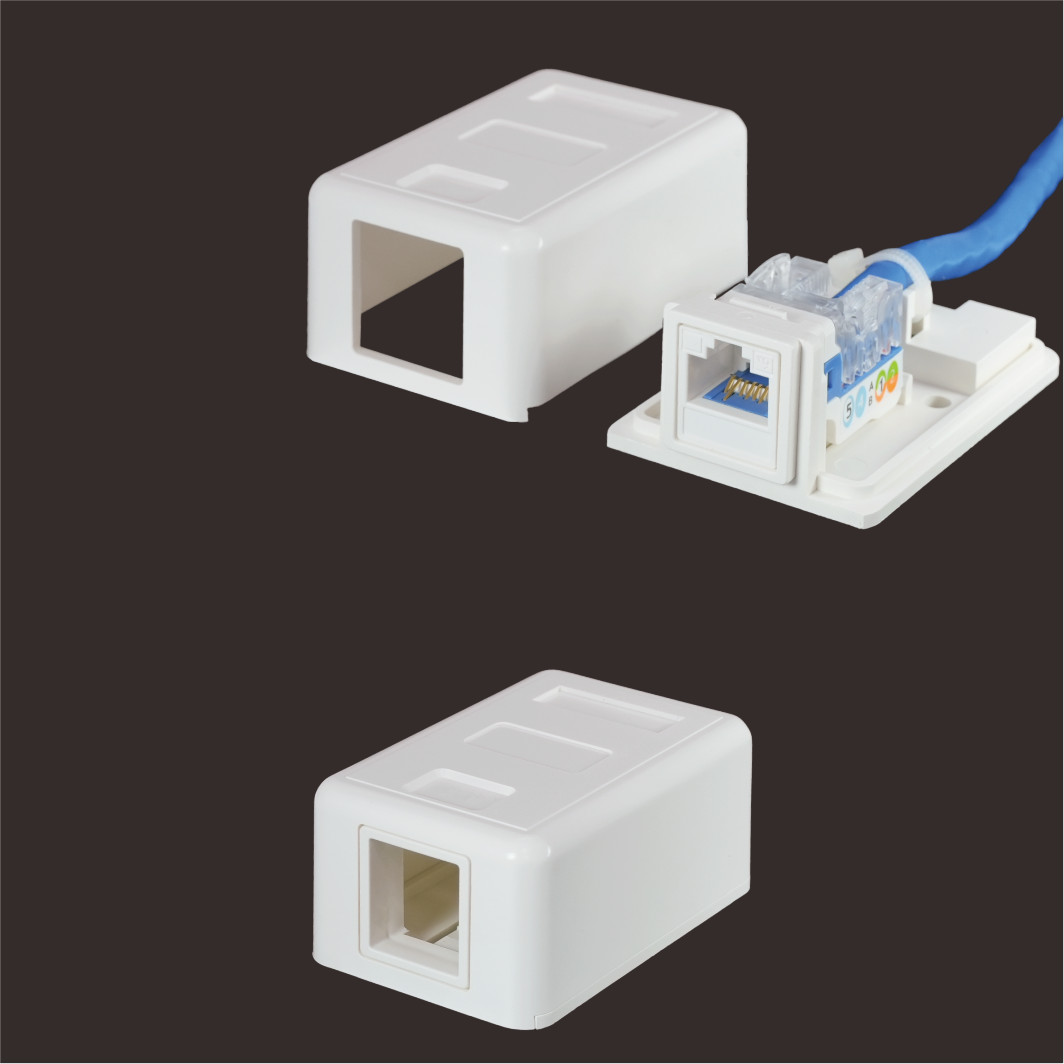
Surface mount boxes offer a convenient solution for adding network drops in open office layouts. In most mobile setups, a simple 2-port box is enough to handle everyday connectivity needs. These boxes can be easily installed using adhesive tape or screws, typically placed near pathway exit points to allow direct wired connections to PCs or laptops.
For higher-capacity setups with 6 to 12 ports, surface mount boxes often function as MUTOAs (Multi-User Telecommunications Outlet Assemblies), as defined in ANSI/TIA-568.1-E. These are used for zone cabling in open, visible areas — commonly near structural columns. In this setup, multiple horizontal cables terminate at the MUTOA, and patch cords run from there through work area pathways or modular furniture to reach end-user devices. One MUTOA can serve up to 12 work areas and must remain easily accessible.

MUTOAs might seem similar to Consolidation Points (CPs), since both are located closer to end devices than the telecom room and serve as intermediate enclosures. However, a key difference is that MUTOAs are located in accessible areas, while CPs are not. Also, CPs are part of the horizontal cable within the 90-meter permanent link, whereas MUTOAs are considered part of the work area and lie beyond that boundary.
Keep in mind: ANSI/TIA-568.2 sets the total channel length at 100 meters — which includes 90 meters of permanent link plus a combined 10 meters for patch cords at both the telecom room and the work area. However, using slimmer, smaller-gauge patch cords like 26AWG or 28AWG has become a growing trend, compared to the standard 24AWG. To help manage this, we’ve included a simple equation and reference chart to help you plan layouts when using thinner cable or extended patch lengths — no calculations needed.

The formula to follow is: (de-rating factor × patch cord length) + horizontal cable length ≤ 102 meters
If you use a 26AWG patch cord, a 3-meter cord on D and another 3-meter cord on E result in a total of 6 meters in the Telecom Room. Meanwhile, let’s assume the 26AWG patch cord extending from the MUTOA on A has a maximum length of 14 meters. A+D+E=20
In this case, the maximum horizontal cable length is reduced to 72 meters to maintain signal integrity, instead of the usual 90 meters.
Because 102−X+(1.5×20)=72, X=allowable horizontal cable length.