
UTP Component
Unshielded

Unshielded Component-Rated Panels
Welcome to HCI’s Unshielded Component-Rated Patch Panel section.
Before exploring our product families, we believe it is essential to address two critical technical questions faced by network designers and installers:
⭐ What Is Component-Rated, and Why Is It Vital for Project Certification?
⭐ Why do Cat 6A UTP Patch Panels look physically distinct from Cat 6 panels?
What Is Component-Rated?
Taking Category 6A as an example, "Component-Rated" signifies that the patch panel independently satisfies the stringent connecting hardware requirements set by ISO/IEC 11801-1 Cat 6a and ANSI/TIA-568.2-E Cat 6A. Connecting hardware limits represent the most demanding electrical test specifications a panel can undergo.

To achieve true Component-Rated, a panel must pass rigorous thresholds for:
- NEXT & FEXT (Near-End and Far-End Crosstalk)
- Return Loss & Insertion Loss
- TCL / TCTL (Transverse Conversion Loss / Transfer Loss for balance)
- Alien Crosstalk (PSANEXT & PSAACRF)
Engineering Note: True Component-Rated validation requires verifying both odd and even ports independently, as interior PCB and pair geometries often differ.
What benefits does this bring me?:
- Ultra-Short Link Support: Ensures reliable performance on ultra-short server links without minimum length restrictions.
- Mix-and-Match Interoperability: Supports mixing compliant cables, outlets, and patch cords from different vendors.
- Interconnection in the Field: Maintains healthy good margins when establishing inter-connects or cross-connects in TRs
Why Do Cat 6A Unshielded Patch Panels Look So Different From Cat 6?
The physical contrast stems directly from high-frequency physics: Cat 6A operating frequencies reach 500MHz, where Alien Crosstalk (AXT) - electromagnetic coupling between adjacent ports - becomes the primary noise barrier to 10GBASE-T transmission. Cat 6 specifications do not enforce AXT compliance, but Cat 6A does.
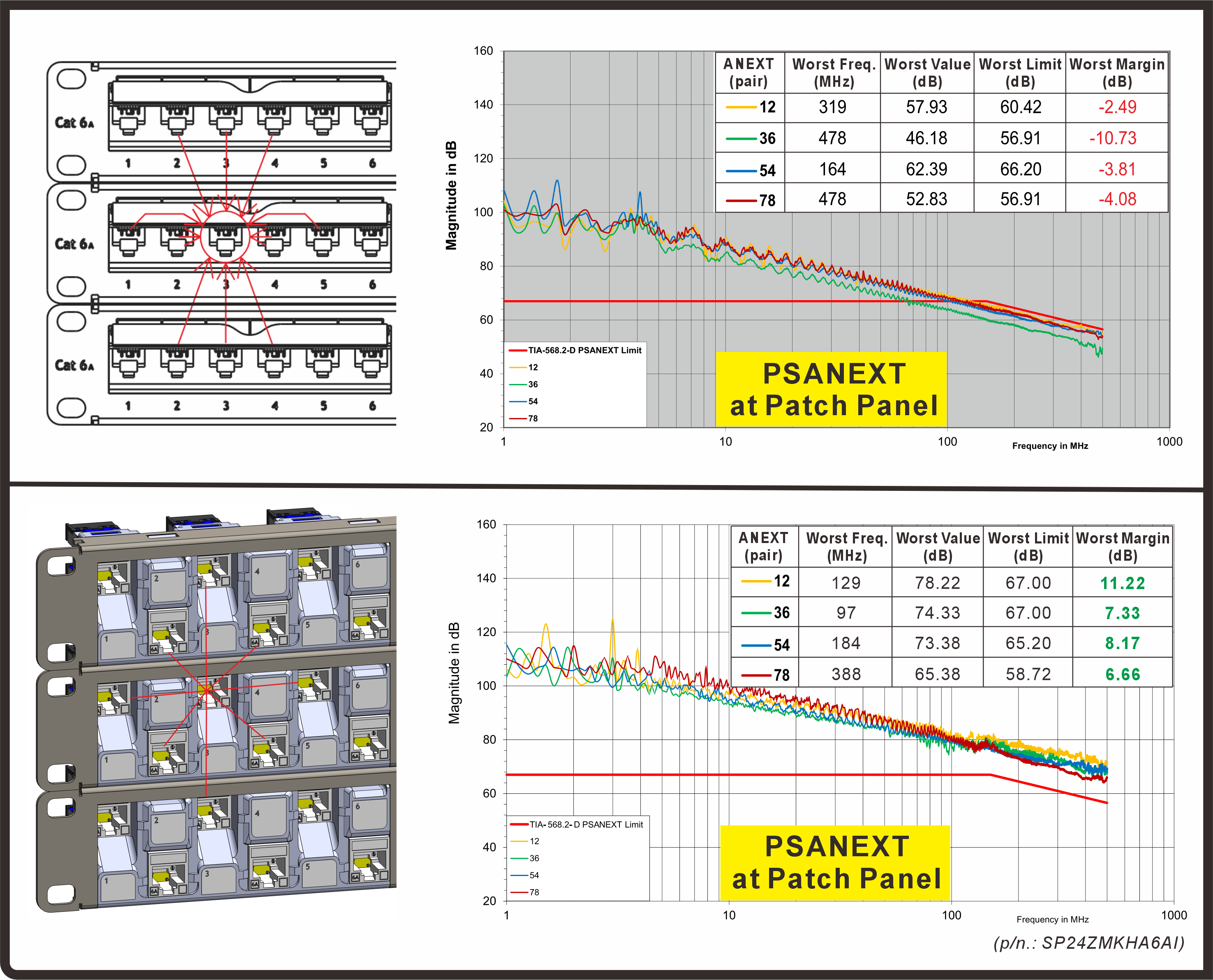
In unshielded designs without metallic screen barriers, dense port packing creates severe port-to-port interference. The two graphs below reveal a striking performance gap:
- Standard Flat Panels (Top Graph): When conventional unshielded panels are stacked shoulder-to-shoulder in a rack, ports line up directly adjacent to each other. As shown in the PSANEXT measurement graph, cumulative Alien Crosstalk severely fails ISO/TIA limits (failing by up to -10.73 dB on worst pairs).
- Patented 3D Staggered Architecture (Bottom Graph - SP24ZMKHA6AI): HCI solves this physical coupling problem through a patented 3D spatial staggered structure (U.S. Patent 9,667,004 B1). By staggering port depths and spacing in three dimensions, physical distance between neighboring connectors is maximized. As demonstrated in the lower test plot, Alien Crosstalk is drastically reduced - delivering fair margin above ISO/TIA limits to ensure smooth, zero-packet-loss 10GBASE-T operation.

Cat 6 Component-Rated Panel Highlights
Because Cat 6 does not require Alien Crosstalk testing, Cat 6 Component-Rated panels focus on maximized installation efficiency and mechanical cable retention. Three key series include:
- BP24KHA Series: Certified Cat 6 Component-Rated panel continuously verified through ETL quarterly testing programs.
- BP24NBI Series: Features integrated rear wire retention clips that lock individual horizontal cables securely in place without strain.
- SP24F2 Series: Front-Access 6-in-1 modular frame pre-loaded with HCI’s Cat 6 Component-Rated keystones for easy front-facing installation.


