

Patch Panels
IDC / Feedthrough

Patch Panels are indispensable in Telecommunications Rooms for managing daily network Moves, Adds, and Changes. That is the foundational perspective from horizontal cabling deployment. However, modern network infrastructure demands much more. Depending on functionality, electrical performance requirements, and real-world installation scenarios, a wide variety of patch panel designs exist to best suit different project needs.
Selecting the optimal patch panel requires evaluating real-world physical environments, project specifications, and bandwidth demands. We recommend following a straightforward 4-step decision process:
Step 1: Shielded vs. Unshielded
- Shielded: In environments surrounded by machinery, motors, or fluorescent lighting arrays, Shielded panels are essential. Full metallic enclosure grounding maintains differential signal balance and total immunity against external Electromagnetic Interference, which is critical for preserving 100-meter channel impedance matching.
- Unshielded: When 10GBASE-T project specifications call for Unshielded Cat 6A cabling in enterprise deployments, the Unshielded Panels you select must be independently validated for Alien Crosstalk compliance. Because field-verifying Alien Crosstalk is extremely complex and time-consuming for contractors, 3rd-party ETL verification provides guaranteed out-of-the-box compliance.
Step 2: Component-Rated vs. Channel-Level
- Component-Rated (Connecting Hardware Limits): Certified against the industry’s most demanding ISO/IEC 11801 and ANSI/TIA-568.2-E connecting hardware specifications. Fabricated with tight manufacturing tolerances and verified across both odd and even ports, Component-Rated panels guarantee maximum margin headroom, open vendor mix-and-match freedom, and support for ultra-short server links.
- Channel-Level (Channel & Permanent Link Limits): Measured within a complete mixed cabling layout against Permanent link & Channel limits. Both Permanent Link and Channel limits offer a wider acceptance window and rely on vendor-matched links. Engineering Rule: A panel passing strict Component-Rated connecting hardware limits will always pass Channel limits - but a Channel-Level panel cannot guarantee Component-Rated compliance.
Step 3: Cat 6A vs. Cat 6 Performance Tier
- Cat 6A: Market intelligence from research institutions like BSRIA highlights a decisive shift: Category 6A has officially surged ahead of Category 6 as the dominant global copper cabling standard. Driven by the rapid expansion of AI workloads, Wi-Fi 6/6E access points, and 90W PoE++ (IEEE 802.3bt) remote powering, Cat 6A represents the definitive baseline for 10Gbps and superior thermal dissipation required to future-proof modern enterprise networks.
- Cat 6: But that doesn’t mean Cat 6 is fading out. On the contrary, Cat 6 remains exceptionally well-suited for mainstream media streaming and supports 10Gbps transmission at distances up to 55 meters. Furthermore, HCI Super Cat 6 panels P/N. BP24KHA6S provide ample headroom for 5GBASE-T, delivering the exact multi-gigabit throughput required by Wi-Fi 6 access points. Looking ahead to extended-reach applications, guidelines outlined in TSB-5073 also demonstrate how 4-pair balanced twisted-pair cabling utilizes 21 AWG Cat 6 copper to enable long-distance deployment of 90W high-power PoE alongside network data over extended channels, reaching up to 250m at 10Mbps.
Step 4: RJ-45 to IDC vs. RJ-45 to RJ-45
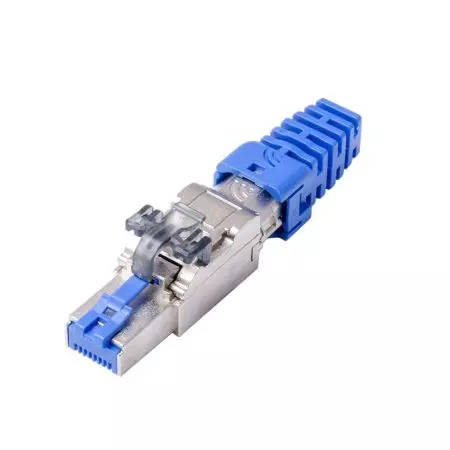
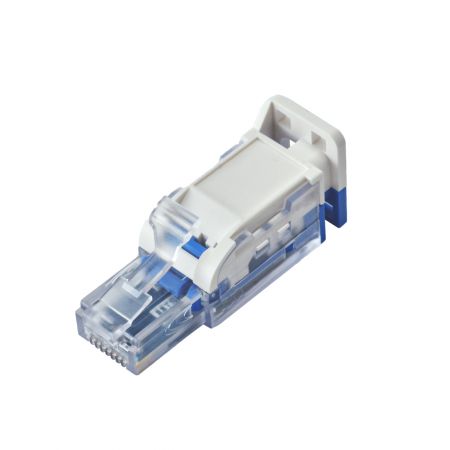
- RJ-45 to IDC Type (Permanent Link Termination): Installers terminate incoming twisted-pair cables directly onto the rear-panel IDCs, establishing the Permanent Link between the work area outlet and the TR. The patch panels generally come in two designs: pre-configured and keystone type. Pre-configured type feature fixed IDCs for high-volume installation, and modular keystone panels allow installers to punch down individual keystone jacks and snap terminated jacks back into the blank panel. Both methods are highly convenient, and each holds a strong market share based on installer workflow preference.
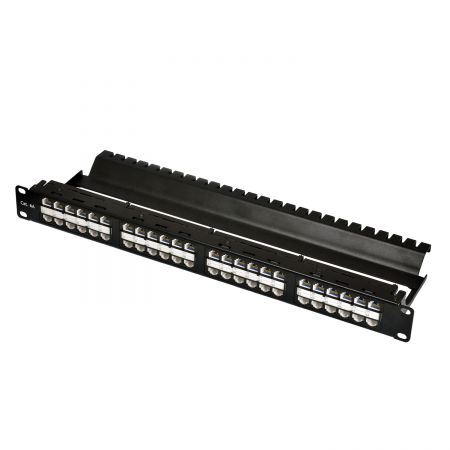
- RJ-45 to RJ-45 Feed-Through Type (Cross-Connect & Interconnect): In enterprise deployments, a second patch panel layer is frequently added for cross-connect management and patching to active equipment. Feed-Through (Coupler) panels feature female RJ-45 connectors on both front and rear, enabling plug-and-play patching using factory pre-terminated, custom-length patch cords plug directly into both sides - completely eliminating punch-down labor. While standard couplers introduce NEXT penalties on short channels, HCI High-Density 1U-48P Feed-Thru Panels (available in both UTP and STP) utilize internal impedance-matching circuitry to restore full transmission margins across worst-case 1-meter short links.

All HCI patch panel solutions are systematically categorized by physical architecture, electrical performance, and installation topology - making filtering and selection straightforward for every network scenario. Whatever specification your deployment calls for, you will find the right solution in HCI’s Patch Panel portfolio.
We fully support OEM manufacturing and private-label branding to help custom brand partners launch certified, market-ready connectivity lines with full technical backup. Should your project demand a specialized layout, customized performance spec, or custom packaging, our engineering team and sales representatives are ready to assist!


